Regulatory Signals
Regulatory Signals
Germany Tightens Access to Medical Cannabis
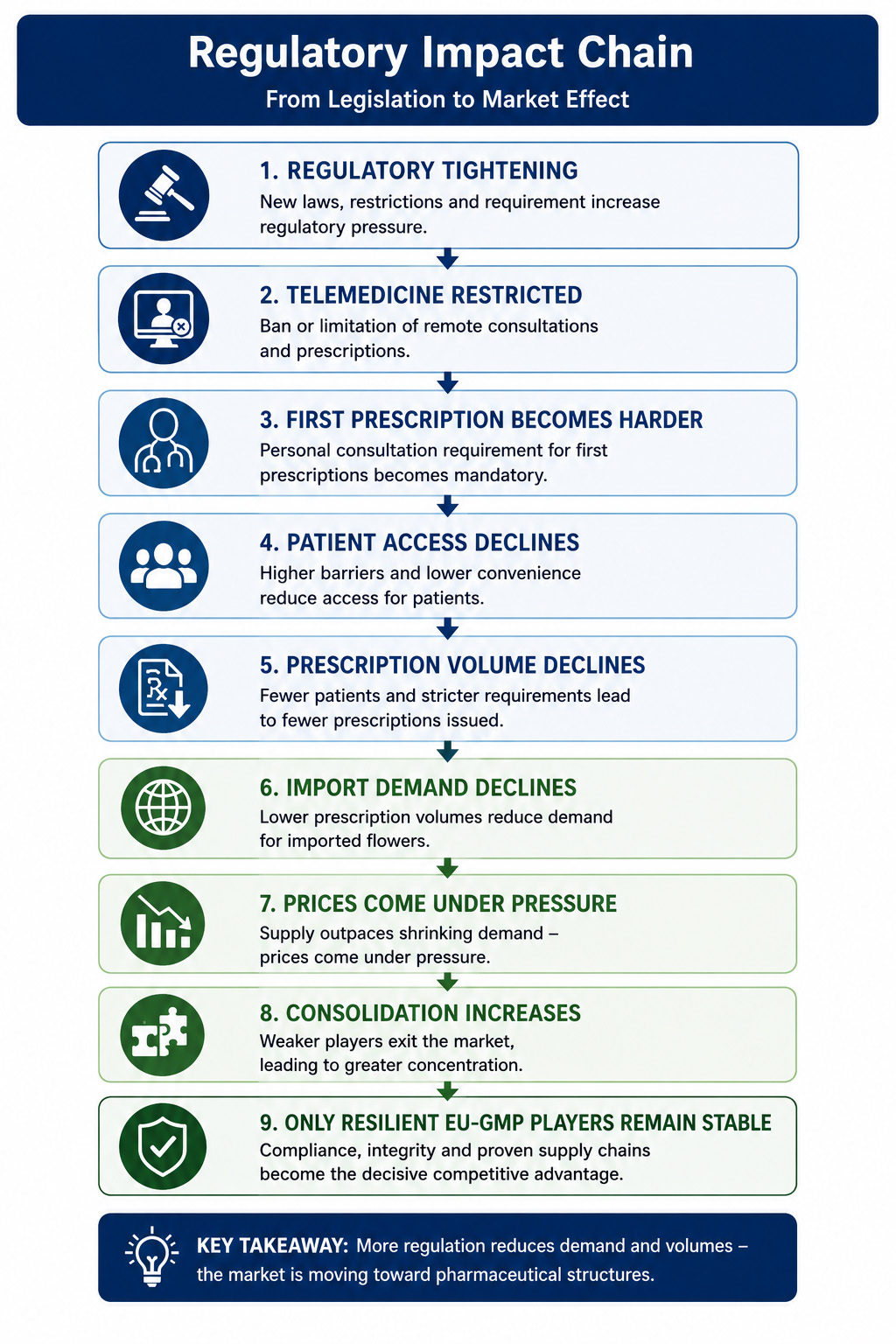
The regulatory framework for medical cannabis in Europe is undergoing noticeable change. Germany in particular is currently sending signals that could have significant implications for demand, prescribing patterns and overall market structure. The current draft amendment to the MedCanG includes, among other measures:
- mandatory in-person consultations for first prescriptions instead of purely telemedical access,
- restrictions on remote prescribing,
- a ban on traditional mail-order distribution.
At the same time, Germany’s Federal Court of Justice ruled that advertising for cannabis treatments may violate the Heilmittelwerbegesetz (German Act on the Advertising of Medicinal Products).
For the market, this means one thing above all: Growth is becoming increasingly regulated. The development is reminiscent of Poland, where comparable restrictions initially led to a sharp decline in prescription volumes before the market gradually stabilized. At the same time, other markets are also professionalising their regulatory structures:
- Spain is limiting medical cannabis to standardized hospital-based preparations,
- Thailand is shifting the market decisively toward medical infrastructure,
- Israel is discussing restrictions on inhalable cannabis products.
The trend is clear: The European market is moving away from consumer-oriented models and increasingly toward traditional pharmaceutical structures.
For international producers, the bottleneck is therefore no longer cultivation itself, but the ability to establish regulatory-resilient and fully traceable supply chains.
TONNEX continuously monitors these developments and evaluates their impact on market access, EU-GMP processes and international supply-chain structures.