EU Market Access
EU Market Access
Why Germany, why TONNEX, why now
The real bottleneck is not cultivation — it is EU market access.
Global production capacity for medical cannabis continues to grow. At the same time, one thing is becoming increasingly clear: production is not the critical factor — controlled access to regulated EU markets is.
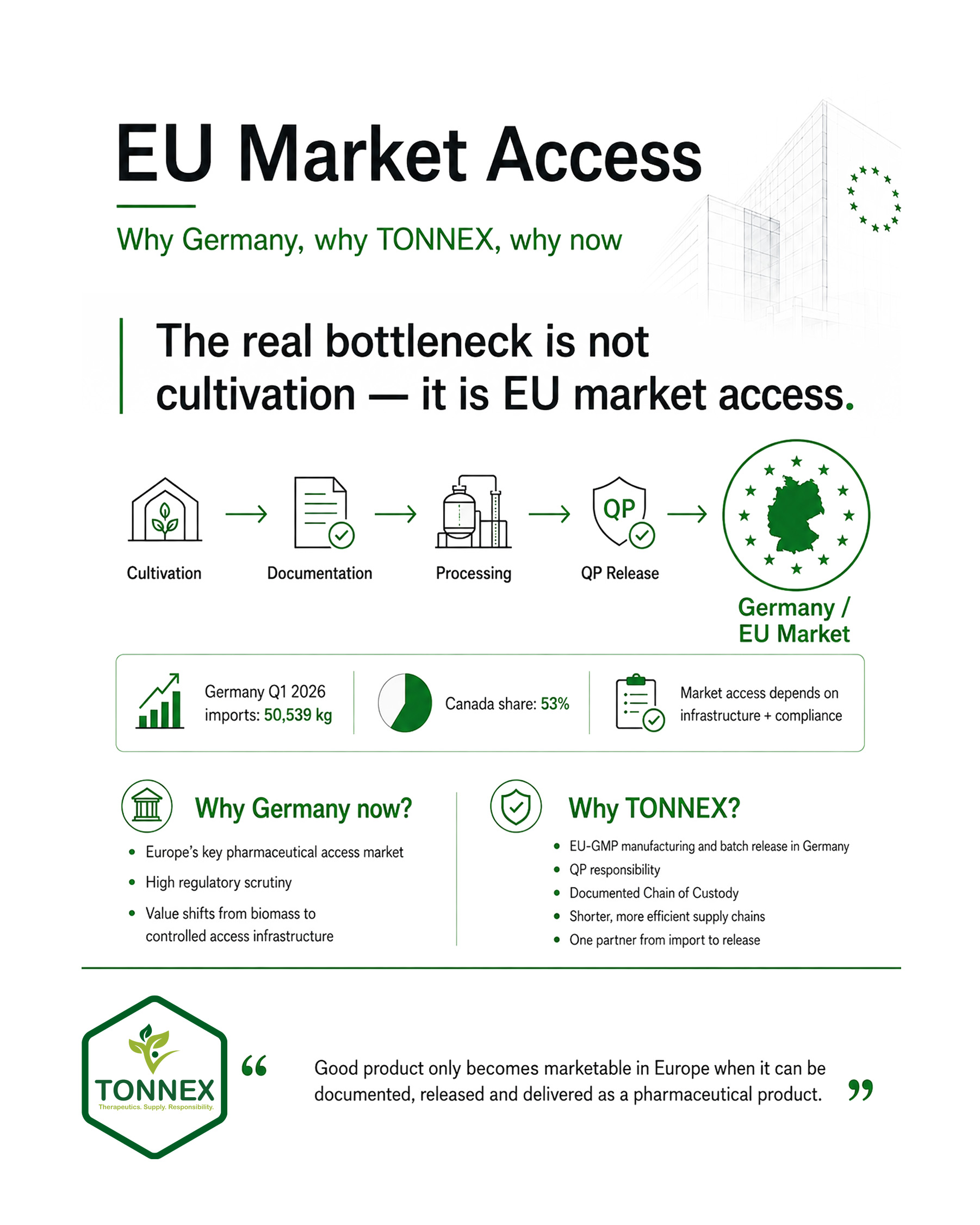
In the first quarter of 2026, Germany imported more than 50 tonnes of medical cannabis flower. Canada remains dominant, while the origin base is becoming increasingly diversified: Australia, Colombia, North Macedonia, the UK/Jersey and now Czechia are gaining relevance. Germany imported 50,539 kg in Q1 2026, with Canada accounting for 26,753 kg, or 53% of imports.
This matters because Germany is not just another target market.
It is Europe’s most relevant pharmaceutical access point for medical cannabis — but also one of its most demanding. Every import and export of medical cannabis requires the relevant authorisation under the MedCanG framework, and market access is shaped by documentation, competent authority expectations, release processes and controlled supply chains.
That is why the question is no longer: Who can cultivate?
The question is: Who can bring international production into a release-ready European pharmaceutical process?
The answer is becoming more urgent.
Germany’s MedCanG amendment remains a live regulatory signal. The current draft provides that prescriptions for medical cannabis flower require personal contact between physician and patient, while the policy debate around telemedicine and distribution structures continues.
For international producers, this means that Germany should not be treated as a simple sales channel. It is a regulated pharmaceutical market where access depends on robustness: documentation, batch logic, auditability, QP responsibility, release capability and GDP-compliant logistics.
This is precisely where the real value-creation zone of the European market is emerging.
Why choose EU-GMP manufacturing and batch release in Germany with TONNEX?
For international producers, the strategic question is no longer whether Europe is attractive.
The question is how to enter the market without building an entire EU-GMP infrastructure from the ground up.
This is where Germany becomes relevant — and where TONNEX creates value.
With TONNEX, producers gain access to EU-GMP manufacturing and batch release in Germanythrough an established German pharmaceutical infrastructure. That means no separate investment in German manufacturing capacity, quality systems or dedicated regulatory resources is required before entering the market.
Instead of moving product across multiple countries for finishing, documentation and release activities, producers can work with one German partner managing the critical interface between import, processing, quality assurance and market release.
The commercial logic is clear:
- less logistics,
- less regulatory complexity,
- less handling risk,
- faster turnaround times,
- shorter supply chains,
- lower working capital requirements,
- and improved planning reliability.
For international producers, this can translate into faster time to market, reduced compliance risk and more efficient commercialization.
TONNEX combines German pharmaceutical expertise, flexible capacity for both smaller and larger volume programs, QP release by a German EU-GMP manufacturer, GDP-compliant logistics and direct proximity to pharmacies, pharmaceutical wholesalers and distribution partners in Germany and Europe.
This is not pure contract manufacturing.
It is a long-term strategic market access model for producers that want to enter Europe with lower capital commitment, stronger process control and a partner that understands the regulatory expectations of the German pharmaceutical market.
In short: EU-GMP manufacturing and batch release in Germany by TONNEX means less friction between international production and European marketability.
It reduces the need for producers to build their own infrastructure, shortens the path from product arrival to market release, and connects international supply with German quality, compliance and pharmaceutical execution.
Another notable development: Portugal’s previously strong role as a European processing location is beginning to shift. Czechia and Switzerland are increasingly developing into alternative EU-near processing and finishing hubs. Each new origin extends the operational chain: GACP production, transport, processing, decontamination, documentation, release and EU-GMP market integration must interact cleanly.
At the same time, capital is moving in the same direction.
Organigram’s acquisition of Sanity Group valued the German platform at up to €250 million, with the transaction explicitly tied to European market scale, regulatory expertise and supply-chain infrastructure. Aurora’s acquisition of Safari Flower was framed around expanding EU-GMP capacity for international medical markets including Germany, Poland and the UK. Canify and MG Health described their planned merger as a vertically integrated platform spanning production, pharmaceutical processing and multi-market distribution.
The signal is clear:
the market is not only investing in biomass. It is investing in controlled access infrastructure.
For producers outside Europe, this changes the investment logic.
Owning biomass is no longer enough. What matters is the ability to demonstrate regulatorily robust and auditable supply chains:
- traceable Chain of Custody,
- valid quality documentation,
- controlled processing,
- QP release capability,
- robust EU-GMP structures.
This is also why TONNEX matters in the current market phase.
TONNEX is not an intermediary. TONNEX is a regulatory production, release and market access partner for international producers that want to enter Europe not only commercially, but pharmaceutically.
Through EU-GMP manufacturing and batch release in Germany, QP responsibility, documented processes, Chain-of-Custody control, GDP-compliant logistics and controlled processing infrastructure, TONNEX sits at the point where international cannabis production becomes a release-ready pharmaceutical product for the European market.
Investing in Germany now means investing in the market where European demand, regulatory scrutiny and pharmaceutical infrastructure converge.
Investing with TONNEX means investing in the layer that makes access defensible: not another trading route, but the process architecture between cultivation and European marketability.
EU market access is therefore increasingly becoming a question of infrastructure and compliance — not a question of production volume.
Good product matters.
But in Europe, good product only becomes marketable when it can be documented, released and delivered as a pharmaceutical product.
That is the difference between reaching Europe — and being able to stay in Europe.