The Structural Picture
The Structural Picture
Why the European cannabis market is undergoing structural change
Many market analyses still focus on prices, flower volumes or new cultivation capacity. But the real shift is taking place at a deeper level:
The market structure itself is changing.
Europe is moving away from a market defined mainly by product availability — and toward a market defined by regulatory credibility, documented processes and pharmaceutical supply capability.
For international producers, this creates a clear challenge:
Good flower alone does not create European market access.
Between international cultivation and reliable European supply stands a pharmaceutical conversion process.
This is where TONNEX operates.
Through EU-GMP manufacturing and release in Germany, QP responsibility, documented Chain of Custody and GDP-compliant logistics, TONNEX helps convert internationally produced cannabis into a product that can stand within the European pharmaceutical system.
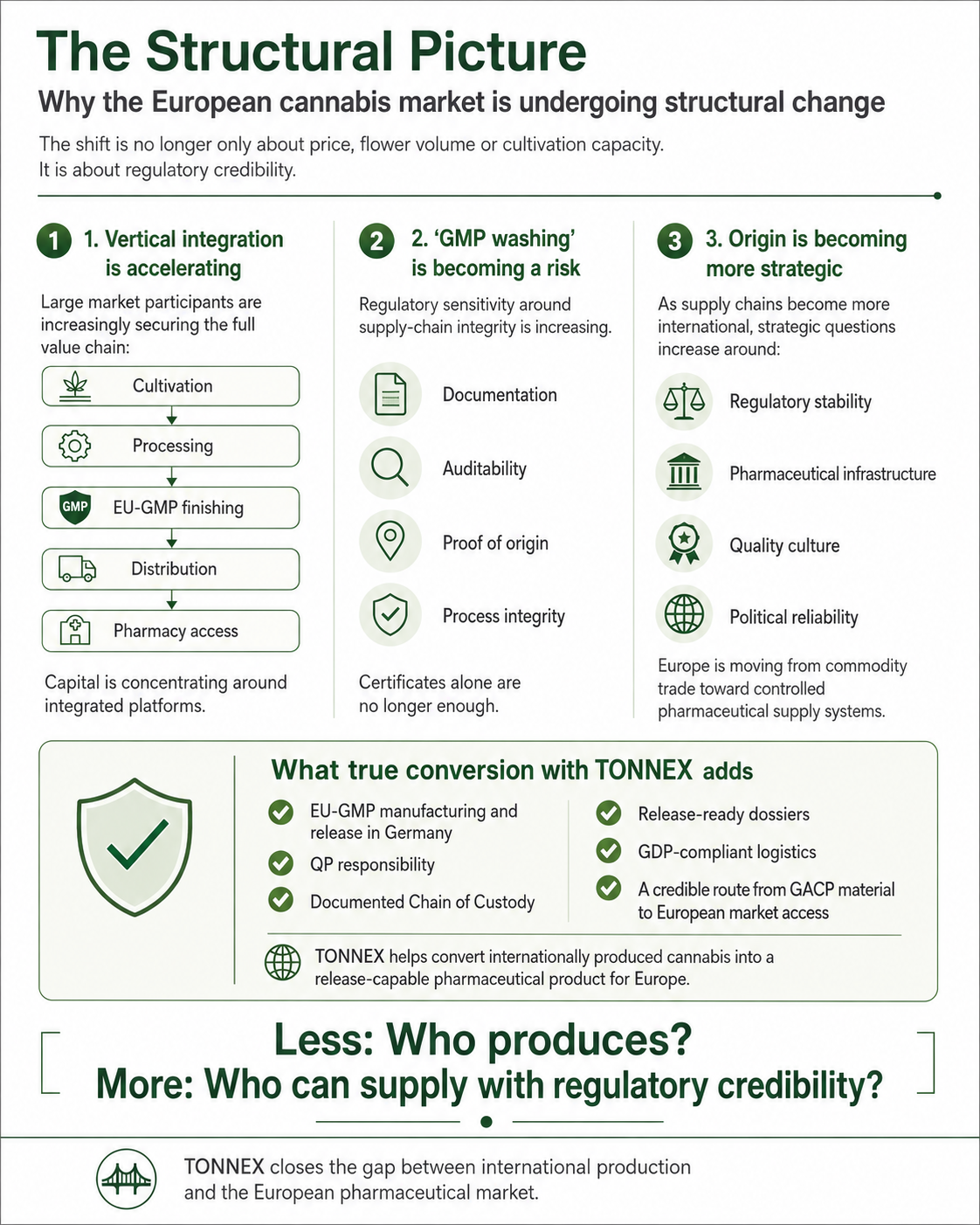
Three developments are currently shaping this shift.
1. Vertical integration is accelerating
Large market participants are increasingly securing the full value chain: cultivation, processing, EU-GMP finishing, distribution and pharmacy access.
Transactions such as:
- Organigram / Sanity Group,
- Aurora / Safari Flower,
- Canify / MG Health
make one point clear:
Capital is concentrating around a small number of integrated platforms.
For independent international producers, this raises the threshold for European access.
The question is no longer only whether a producer can cultivate at scale. The question is whether that producer can connect to a robust European pharmaceutical infrastructure.
This is the advantage of true conversion with TONNEX:
Material does not simply move from origin to market. It is translated into a controlled, documented and release-capable pharmaceutical process.
That means:
audit-ready documentation, clear responsibility for release, traceable Chain of Custody, GDP-compliant downstream movement, and a German EU-GMP manufacturing and release framework.
In a consolidating market, this gives producers a route to Europe without having to build the entire infrastructure themselves.
2. "GMP washing" is becoming a risk
At the same time, regulatory sensitivity around supply-chain integrity is increasing.
The term "GMP washing"describes products that are formally presented as EU-GMP, while the actual supply, processing and documentation structures remain only partially transparent.
New standards such as the CSQ EU-GMP Addendumare increasing pressure on:
- documentation,
- auditability,
- proof of origin,
- process integrity.
This is where the difference between a label and a process becomes decisive.
A certificate alone is not enough if the path from cultivation to release cannot be explained, documented and defended.
TONNEX addresses this exact gap.
The value is not merely in access. It is in credible conversion:
- from GACP material to EU-GMP manufacturing,
- from product data to a release-ready dossier,
- from origin claim to documented Chain of Custody, from available biomass to a
- pharmaceutical product that can enter regulated supply.
In a market increasingly alert to GMP washing, transparency becomes a commercial asset.
3. Origin is becoming more strategic
The more international supply chains become, the more relevant questions become around:
- regulatory stability,
- pharmaceutical infrastructure,
- actual quality culture,
- political reliability.
Origin matters. But origin alone does not decide market readiness.
A strong cultivation country still needs a reliable European conversion pathway. A capable producer still needs validated processes, documentation, QP release and controlled logistics.
The market is therefore moving further away from pure commodity trading — and toward controlled pharmaceutical supply systems.
The central question in future will be less: "Who produces?"
And increasingly: "Who can supply with regulatory credibility?"
For TONNEX, this is the core of the market-access role. TONNEX is not a broker between producer and buyer. TONNEX closes the gap between international production and the European pharmaceutical market — through EU-GMP manufacturing and release in Germany, documented process control and a supply-chain architecture designed for regulatory credibility.
In the next phase of the European cannabis market, the competitive advantage will not belong only to those who grow well. It will belong to those who can convert quality into compliance, documentation into trust and international production into reliable European supply.
Europe does not reward product claims. Europe rewards documented pharmaceutical credibility.
And that credibility is created in the conversion process — where origin, documentation, manufacturing, release and logistics become one controlled supply chain.